
Not every glass product imported into the United States is covered by the same trade measures. Under the U.S. antidumping duty order on float glass products from China, coverage depends on the glass composition, manufacturing process, dimensions, product configuration, and country of origin. Understanding these requirements is essential for importers, distributors, and manufacturers sourcing glass products for the U.S. market.
Published by the U.S. Department of Commerce on April 6, 2026, the order specifically identifies float glass products, including certain tempered glass products, laminated glass, insulating glass units, and LED mirrors. It also lists several product exclusions. This guide explains the written scope and the key details businesses should review before importing.

The Legal Background of the U.S. Antidumping Order
The U.S. Department of Commerce issued the antidumping duty order on float glass products from the People's Republic of China under investigation case number A-570-188.
- February 9, 2026: Commerce published its affirmative final determination in the investigation.
- March 26, 2026: The U.S. International Trade Commission notified Commerce of its final affirmative injury determination.
- April 6, 2026: Commerce published the antidumping duty order in the Federal Register, 91 FR 17250.
- April 24, 2026: A correction to two cash deposit rates was published in the Federal Register, 91 FR 22123.
The order was issued under sections 735(c)(2) and 736 of the Tariff Act of 1930, as amended. Its scope appendix provides the written description of the merchandise covered.
Official source: Federal Register, 91 FR 17250 – Antidumping Duty Order.
What Is Covered by the Order?
The order covers certain float glass products manufactured in China. The legal description defines float glass as soda-lime-silica glass produced by floating a continuous strip of molten glass over a smooth bath of tin, or another liquid metal denser than molten glass.
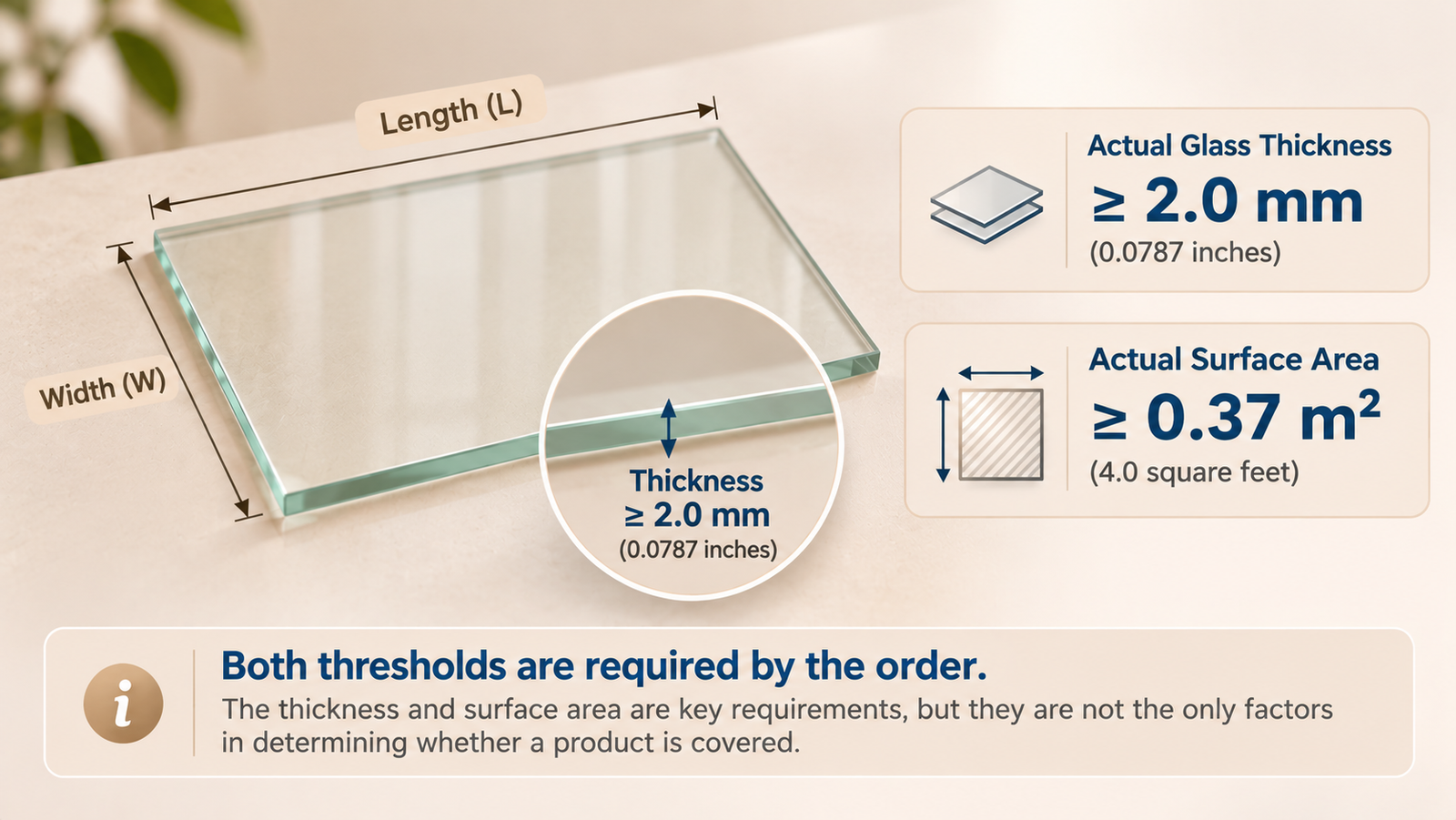
The glass is then cooled in an annealing lehr and cut to appropriate dimensions. To meet the dimensional requirements stated in the order, the product must have both of the following characteristics:
Two Main Dimensional Thresholds
ACTUAL GLASS THICKNESS
≥ 2.0 mm
0.0787 inches
ACTUAL SURFACE AREA
≥ 0.37 m²
4.0 square feet
Both thresholds must be assessed. Meeting the thickness threshold alone or the surface-area threshold alone does not establish that a product is covered. The glass type, manufacturing process, origin, product configuration, and exclusions must also be reviewed.
The order further states that float glass products may be clear, stained, tinted, or coated with one or more materials. Therefore, a coating or a particular color does not automatically place a product outside the scope.
Which Float Glass Products Are Included?
The order covers more than basic flat glass sheets. Its written scope identifies several product categories and assemblies that may remain covered when they meet the applicable requirements.
1. Clear, Stained, Tinted, and Coated Float Glass
The scope includes qualifying soda-lime-silica float glass in clear, stained, tinted, and coated forms. Examples of coated products include certain Low-E architectural glass products.
The presence of a coating or tint does not, by itself, determine whether the product is excluded. Importers should assess the complete technical description and any specific exclusion listed in the order.
2. Tempered Glass for Tub and Shower Enclosures
The order expressly includes tub and shower enclosure doors and panels made of tempered glass, which may be sold with or without attached hardware.
Important distinction: For these products, the scope covers the tempered glass itself and excludes non-glass hardware.

3. Laminated Glass
The order includes laminated glass assemblies consisting of two or more sheets of float glass bonded together using a polymer interlayer.
The relevant distinction is the construction of the assembly: multiple float glass sheets are bonded using an interlayer. Importers should not assume that every multi-layer glass product qualifies without checking the written description.
4. Insulating Glass Units (IGUs)
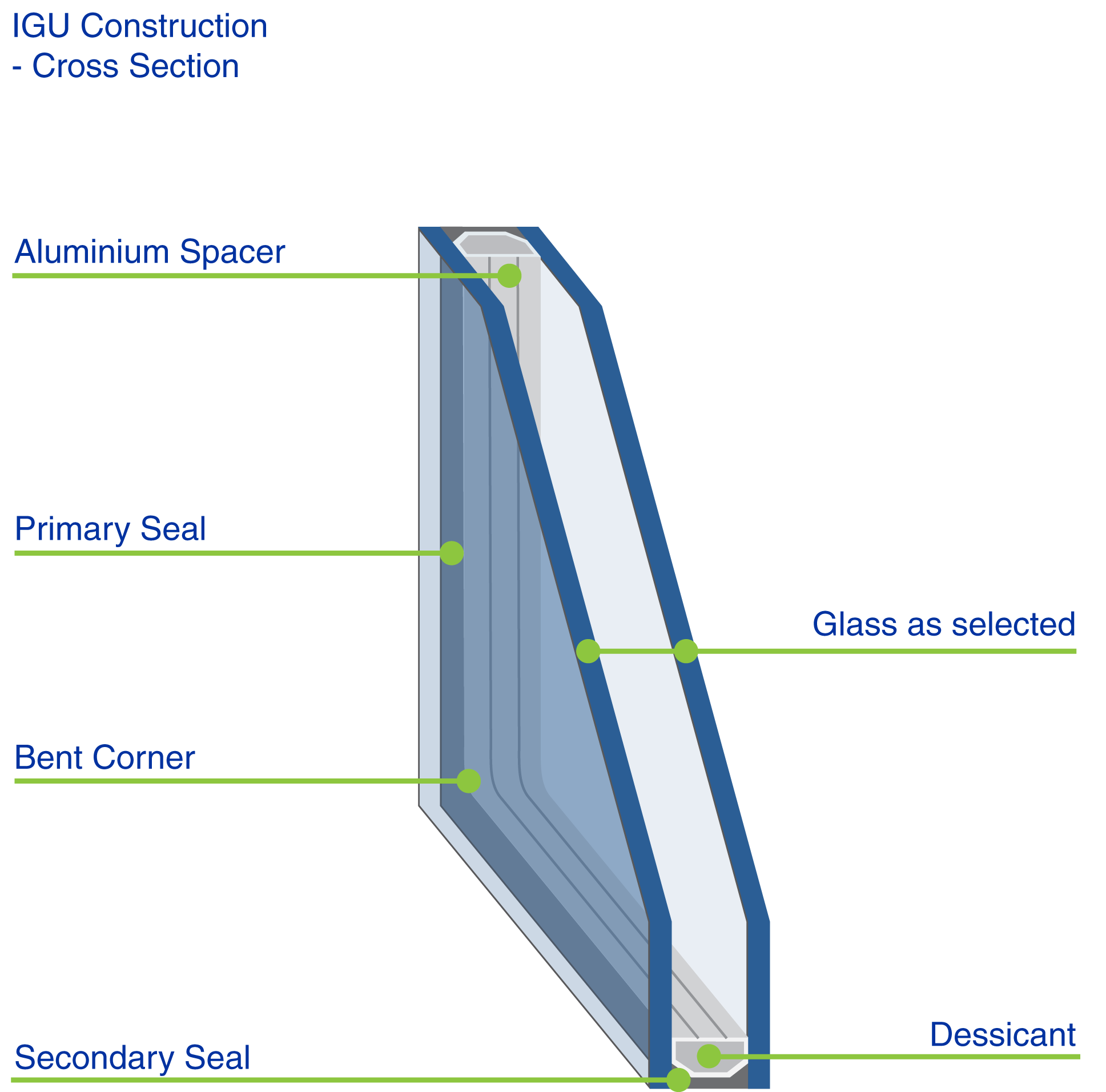
The scope also includes qualifying insulating glass units. These consist of two or more sheets of float glass separated by a spacer and hermetically sealed at the edges to create a thermal barrier using air or one or more gases.
The order specifies that certain non-float glass components mounted between the sheets, such as blinds, wrought iron cores, and camed patterned glass, are outside the scope and are not subject to duties under this order.
5. LED Mirrors
LED mirrors are specifically identified in the order as one of the included float glass assemblies.
The description covers:
- Float glass mirrors with one or more light-emitting diodes attached to or integrated with the mirror.
- Framed float glass mirrors with one or more LEDs attached to or integrated with the mirror or the mirror frame.
The order describes these LED mirrors as products without other electronic functionality such as digital or video displays or audio circuitry.
This means that the presence of LED lighting does not automatically make every mirror covered. The underlying glass must still be evaluated against the scope, including its composition, manufacturing process, dimensions, and origin.

Key Technical Requirements Importers Should Understand
The order refers to several ASTM specifications and standards that may apply to float glass products. It also states that products covered by the scope meet the requirements of Type I under ASTM C1036 before further treatment, finishing, or fabrication.
The order lists the following standards and specifications:
ASTM References Listed in the Order
- ASTM C162
- ASTM C1036
- ASTM C1048
- ASTM C1172
- ASTM C1349
- ASTM C1376
- ASTM C1422/C1422M
- ASTM C1464
- ASTM C1503
- ASTM C1651
- ASTM E1300
- ASTM E2190
These references are included in the order's scope description. Their appearance in the list does not mean every product meeting one of these standards is automatically covered. The complete written scope remains controlling.
Does Further Processing Remove Float Glass from the Scope?
No, not automatically. The order explicitly states that qualifying float glass products may undergo further work and remain within the scope, regardless of where that additional work takes place.
The listed operations include:
- Cutting
- Beveling and edging
- Notching and drilling
- Etching and engraving
- Bending and curving
- Chipping and embossing
- Surface grinding and polishing
- Sandblasting
The key condition is that the original soda-lime-silica glass satisfied the requirements of ASTM C1036 Type I and was first manufactured in a country covered by the order. Subsequent processing in another location does not, by itself, remove the glass from the scope.
What this means for importers:
A product may be cut, polished, drilled, or otherwise processed outside China and still fall within this specific order if the original float glass was manufactured in China and satisfies the applicable scope requirements.
Which Products Are Excluded from the Order?
The order identifies specific product categories that are excluded from its scope. Importers should review these exclusions carefully instead of assuming that a product is excluded based only on its appearance or commercial name.
Main Product Exclusions
- Wired glass: Glass with a layer of wire mesh embedded within it.
- Certain patterned flat glass: Rolled glass with a pattern impressed on one or both sides that meets Type II under ASTM C1036, including specified greenhouse and patterned solar glass.
- Certain vehicle safety glazing: Safety glazing materials for vehicles certified to ANSI Standard Z26.1.
- Vacuum insulating glass (VIG): Specified units using a gas-free vacuum as a thermal barrier.
- Framed mirrors without LEDs: Framed mirrors without LEDs integrated with the mirror or its frame.
- Certain over-the-door mirrors: Unframed mirrors ready for use as imported without further processing, finishing, or fabrication after importation.
- Certain washing machine lid glass: Heat-strengthened glass with an actual surface area below 6.0 square feet (0.56 square meters).
Specific Solar Glass Exclusions
The order also identifies two technical categories of solar glass that are excluded:
- Coated solar glass meeting the specified iron oxide content, annealing, surface compression, coating, and thickness requirements.
- Clear back solar glass meeting the specified heat-treatment, surface-compression, drilled-hole, and thickness requirements.
These are technical exclusions with specific conditions. A product should not be classified as excluded solar glass without checking every applicable characteristic in the order.
The order also excludes certain metal-camed glass products where the constituent glass panels would otherwise be excluded because of their size or because they consist of qualifying Type II patterned flat glass. Products already covered by certain other existing antidumping or countervailing duty orders are also excluded from this order.
For the full legal wording, consult the official scope appendix.
How Is the Country of Origin Determined?
For this order, the country of origin is determined by where the soda-lime-silica glass is first manufactured through the float process and cooled in an annealing lehr.
The order states that this determination applies regardless of where downstream finishing or fabrication operations take place.
This distinction matters for businesses that source glass in one country and complete cutting, polishing, fabrication, or assembly in another. The shipping country or final processing location alone does not establish the origin under this specific order.
Practical example:
If qualifying float glass is first manufactured in China and later cut or polished in Vietnam, the downstream processing location does not automatically change the glass origin for purposes of this order.
This example explains the origin provision in this particular order. It should not be treated as a universal country-of-origin rule for every U.S. customs or trade measure.
What Are the Relevant HTSUS Codes?
The order lists Harmonized Tariff Schedule of the United States (HTSUS) classifications under which subject merchandise may enter. These include:
HTSUS Subheadings Listed in the Order
Primary listed subheadings:
- 7005.10.8000
- 7005.21.1010
- 7005.21.1030
- 7005.21.2000
- 7005.29.1810
- 7005.29.1850
- 7005.29.2500
- 7007.29.0000
- 7008.00.0000
- 7009.91.5010
- 7009.91.5095
- 7009.92.5010
Additional subheadings under which products may enter:
- 7006.00.4010
- 7006.00.4050
- 7007.19.0000
- 7013.99.2000
- 7013.99.9090
- 7610.10.0030
- 7610.90.0080
Important: The Federal Register expressly states that HTSUS subheadings are provided for convenience and customs purposes. The written description of the scope is dispositive. Therefore, an importer should not rely on an HTSUS code alone to decide whether merchandise is covered.
What Should Importers Verify Before Shipping?
Before purchasing or importing float glass products from China, buyers should collect enough technical and manufacturing information to compare the merchandise with the written scope.
Importer Verification Checklist
- Confirm whether the material is soda-lime-silica glass.
- Identify whether it was manufactured through the float process.
- Verify actual thickness and surface area.
- Identify whether the product is clear, tinted, stained, or coated.
- Determine whether the product is tempered, laminated, an IGU, a shower enclosure, or an LED mirror assembly.
- Check whether any specific exclusion applies.
- Identify where the original float glass was manufactured.
- Retain product specifications and available manufacturing records.
- Review the written scope with a qualified U.S. customs or trade compliance professional if coverage is uncertain.
These checks help importers identify potential scope issues before shipment. They do not replace a formal scope determination by the U.S. Department of Commerce or advice from qualified trade professionals.
Why Accurate Product Information Matters for Glass Suppliers
For glass processors, mirror manufacturers, and exporters, accurate product information is important when working with U.S. importers. Buyers may need details about material composition, dimensions, manufacturing methods, finishing operations, and original glass production location.
A clear technical file helps customers understand what they are purchasing and gives their customs or trade compliance advisers information to assess the product against the applicable legal scope.
For manufacturers serving international customers, maintaining consistent product specifications and transparent manufacturing records can support a more reliable sourcing process.
Frequently Asked Questions
1. Does the U.S. antidumping order cover all float glass products?
No. The order covers float glass products from China that meet its written scope. Certain product categories and technical exclusions are specifically identified in the order.
2. What is the minimum glass thickness under the order?
The order specifies an actual thickness of at least 2.0 mm and an actual surface area of at least 0.37 square meters. Both dimensional thresholds must be considered along with the other scope requirements.
3. Are tempered shower enclosure panels included?
The order expressly includes tub and shower enclosure doors and panels made of tempered glass. The scope covers the tempered glass and excludes non-glass hardware.
4. Are LED mirrors included in the order?
Yes. The scope includes qualifying float glass mirrors with one or more LEDs attached to or integrated with the mirror, including certain framed LED mirrors. The specified electronic-functionality limitations and other scope requirements also apply.
5. Does cutting or polishing float glass in another country remove it from the scope?
Not automatically. The order states that further-worked float glass can remain covered if the original glass met the applicable requirements and was first manufactured in a subject country.
6. Are framed mirrors without LED lighting covered?
Framed mirrors without LEDs integrated with the mirror or frame are expressly listed among the exclusions.
Looking for a Reliable Mirror Manufacturing Partner?
For bathroom mirror brands, wholesalers, and distributors, understanding product materials and manufacturing processes is an important part of supplier evaluation. Explore ZW Mirrors' OEM and ODM bathroom mirror solutions for your business requirements.